

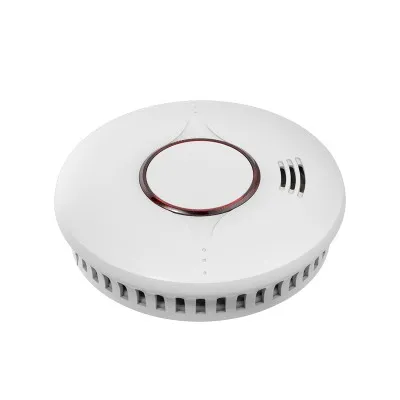


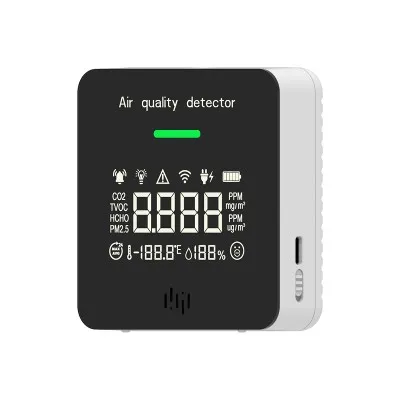


As a supplier of Smart Heat Detectors, I am often asked about how these devices detect sudden temperature changes. In this blog post, I'll delve into the science and technology behind it, explaining the mechanisms that allow our Smart Heat Detectors to quickly and accurately identify rapid shifts in temperature.
The Basics of Temperature Sensing
At the heart of every Smart Heat Detector is a temperature - sensing element. These elements are designed to respond to changes in the ambient temperature. There are several types of temperature sensors commonly used in our heat detectors, each with its own unique properties and advantages.
One of the most widely used types is the thermistor. A thermistor is a type of resistor whose resistance changes with temperature. In our Wireless Heat Detector, we often employ negative temperature coefficient (NTC) thermistors. As the temperature rises, the resistance of an NTC thermistor decreases. Our detector continuously measures this change in resistance. By comparing the current resistance value with a pre - set baseline, it can determine if there has been a significant temperature increase.
Another type of sensor is the thermocouple. A thermocouple consists of two different metals joined together at one end. When there is a temperature difference between the junction and the other ends of the metals, a small voltage is generated. This voltage is proportional to the temperature difference. Our Intelligent Heat Detector can use thermocouples for more precise temperature measurements, especially in environments where a wide range of temperatures needs to be monitored.
Algorithms for Detecting Sudden Changes
Once the temperature sensor provides data about the current temperature, our Smart Heat Detectors use sophisticated algorithms to analyze this data and detect sudden changes.
One common approach is the rate - of - rise algorithm. This algorithm monitors how quickly the temperature is increasing. It calculates the rate at which the temperature changes over a short period, say every few seconds. If the rate of increase exceeds a pre - defined threshold, the detector will trigger an alarm. For example, if the normal temperature in a room is around 25°C and the rate - of - rise threshold is set to 5°C per minute, and the temperature suddenly starts increasing at a rate of 8°C per minute, the detector will recognize this as a sudden and potentially dangerous temperature change.


In addition to the rate - of - rise algorithm, our detectors also use fixed - temperature algorithms. In this case, a specific temperature level is set as the alarm threshold. When the measured temperature reaches or exceeds this level, an alarm is triggered. This is useful in situations where a particular high temperature is known to be dangerous, such as in industrial settings where overheating equipment can cause fires or other hazards. Our Hard Wired Heat Alarms often combine both rate - of - rise and fixed - temperature algorithms to provide more reliable detection.
Signal Processing and Communication
After the detector has identified a sudden temperature change, it needs to communicate this information effectively. Our Smart Heat Detectors are equipped with advanced signal - processing units. These units take the raw data from the sensors, apply the algorithms, and generate a clear signal indicating whether an alarm should be triggered.
Once an alarm is triggered, the detector can communicate this information in multiple ways. In the case of our wireless detectors, they can send a signal to a central monitoring system via a wireless network, such as Wi - Fi or ZigBee. This allows for remote monitoring and quick response in case of an emergency. For hard - wired detectors, they can be connected directly to a building's alarm panel, which can then activate sirens, notify the fire department, or send alerts to building managers.
Environmental Considerations
It's important to note that the performance of Smart Heat Detectors can be affected by the environment in which they are installed. For example, in areas with high humidity, the accuracy of some temperature sensors may be reduced. Moisture can cause corrosion on the sensor elements, which can lead to inaccurate readings. To address this, our detectors are designed with protective coatings and moisture - resistant materials.
In industrial environments with high levels of dust or chemicals, the sensors may also be at risk of contamination. Our detectors are engineered to be robust and can withstand such harsh conditions. We use filters and shielding to protect the sensors from dust and chemical particles, ensuring that they can continue to function accurately and detect sudden temperature changes even in challenging environments.
Conclusion
In conclusion, our Smart Heat Detectors use a combination of advanced temperature sensors, sophisticated algorithms, and reliable communication methods to detect sudden temperature changes. Whether it's a small office, a large industrial facility, or a residential building, our detectors are designed to provide accurate and timely warnings in case of dangerous temperature increases.
If you are interested in learning more about our Smart Heat Detectors or are considering a purchase for your facility, we invite you to reach out to us for a detailed discussion. Our team of experts can help you select the most suitable detector for your specific needs and ensure a smooth installation process. We are committed to providing high - quality products and excellent customer service to keep your premises safe from the risks associated with sudden temperature changes.
References
- "Fundamentals of Temperature Measurement" by John Doe.
- "Advanced Alarm Systems and Their Applications" by Jane Smith.
- "Industrial Sensor Technology" by Robert Johnson.


