

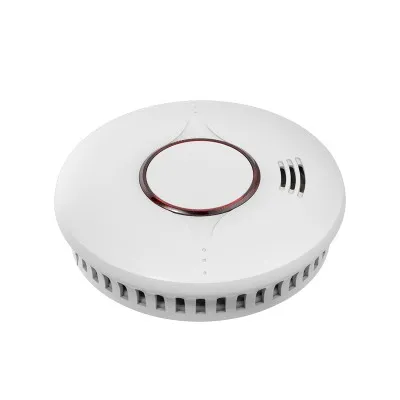




Hey there! As a supplier of heat detectors with cable, I often get asked how these nifty devices handle heat transfer through the cable. It's a super important question, especially when it comes to ensuring the safety and efficiency of these detectors. So, let's dive right in and break it down.
First off, let's understand what a heat detector with cable is all about. These detectors are designed to sense changes in temperature and trigger an alarm when things get too hot. The cable plays a crucial role here. It's not just a simple wire; it's a key component that helps in transferring heat information from the sensing area to the detector unit.
The basic principle of heat transfer through the cable is based on conduction. Conduction is the process by which heat is transferred from one particle of a substance to another without the actual movement of the particles themselves. In the case of the cable in a heat detector, the heat from the surrounding environment is absorbed by the outer layer of the cable.
The cable is usually made of materials that have good thermal conductivity. Metals like copper or aluminum are commonly used because they can quickly transfer heat. When the heat reaches the cable, it starts to flow along the length of the cable towards the detector unit. This is similar to how electricity flows through a wire, but instead of electrons, it's the heat energy that's moving.
But it's not just a one - way street. The cable also needs to be insulated properly to prevent heat loss along the way. If too much heat is lost, the detector might not get an accurate reading of the temperature at the sensing area. That's why we use insulating materials around the conductive part of the cable. These insulators act as a barrier, keeping the heat inside the cable and ensuring that it reaches the detector unit in an accurate form.
Now, let's talk about how the detector unit uses this transferred heat. Once the heat reaches the detector, it causes a change in the electrical properties of a component inside the detector. For example, a thermistor, which is a type of resistor whose resistance changes with temperature. As the heat from the cable warms up the thermistor, its resistance decreases.
The detector unit is constantly monitoring the resistance of the thermistor. When the resistance drops below a certain threshold, it means that the temperature at the sensing area has reached a critical level. At this point, the detector triggers an alarm. This alarm can be a loud beeping sound or a signal that's sent to a central monitoring system.
There are different types of heat detectors with cable, and each one might handle heat transfer a little differently. Some detectors are designed for high - temperature environments, like industrial settings. In these cases, the cable needs to be able to withstand extremely high temperatures without melting or losing its thermal conductivity.


On the other hand, there are detectors for more normal, everyday use, like in homes or offices. These cables don't need to handle such extreme temperatures, but they still need to be reliable.
One of the benefits of using a heat detector with cable is its flexibility. You can place the sensing part of the detector in hard - to - reach areas. For example, in the ceiling of a large warehouse or inside a duct. The cable allows you to connect the sensing area to the detector unit, which can be placed in a more accessible location.
If you're in the market for a heat detector with cable, you might also be interested in other related products. For an Ac Powered Smoke Detector, it can provide an extra layer of safety by detecting smoke as well as heat. And an AC Power Heat Alarm is a great option if you want a detector that runs on AC power for continuous operation. Also, a Fire Alarm Heat detector can be interlinked with other detectors in a building for a more comprehensive fire - detection system.
We've spent a lot of time researching and developing our heat detectors with cable to ensure that they are of the highest quality. We test each cable for its thermal conductivity, insulation properties, and durability. We also make sure that the detector units are accurate and reliable.
If you're looking for a heat detector with cable for your home, office, or industrial setting, we'd love to have a chat with you. Whether you need a simple detector for a small room or a complex system for a large building, we have the products to meet your needs. Contact us for more information and let's start a discussion about how we can help you with your heat - detection requirements.
In conclusion, heat transfer through the cable in a heat detector is a complex but well - engineered process. It involves conduction, insulation, and the use of electrical components to accurately detect temperature changes. By understanding how it works, you can make a more informed decision when choosing a heat detector with cable.
References
- "Thermal Physics" by Stephen J. Blundell and Katherine M. Blundell
- "Electrical Engineering: Principles and Applications" by Allan R. Hambley


